If that is the work you are called to, you do not have to check your faith at the door to do it.
The Catholic Civic Leadership Institute finds, forms, and sends undergraduates, graduate students, and recent graduates to carry Scripture, the Catholic intellectual and moral tradition, and the witness of the saints into their work so they can serve the common good in law, government, business, economics, and public policy, and as citizens, with competence, conviction, and courage. Every profession is a form of citizenship. Open to Catholics, fellow Christians, and all people of goodwill.
Called to lead. Formed in virtue. Sent to serve.
Founded in 2026. Diocesan-affirmed 501(c)(3) operating under the pastoral guidance of the Diocese of Austin.
Every Sunday, the Church prays for those who govern, those who make and judge the laws, and those who labor. You could be the answer to that prayer. The common good is the set of conditions that lets every person in a society flourish, not just most of them, and it is what all of that work is for.
Every institution that shapes how we live is run by people who were once sitting where you are, and almost none of them were ever taught what the Church has to say about the work they actually do. That is a gap, and it will not close by accident. It takes faithful leaders and citizens, formed before they arrive and present once they do.
Since Rerum Novarum in 1891, the Church has built the most sophisticated body of social teaching on earth. She forms you young, through the sacraments, and gathers you into fellowship once you are established. But the decade in between, when your convictions harden into habits and your career takes its shape, is left to whoever gets there first. That is the gap we close, and we close it early, before the world does.
You are not building a résumé. You are being sent, as leaven, into the institutions that decide how we live: the courtroom, the council chamber, the firm, the committee room. Every profession is a form of citizenship, and every one of them turns on decisions the Church has spent two thousand years thinking about. Most people make those decisions with whatever they happen to believe that morning. Your workplace is your mission field. We form you to work it like one.
Everything we teach is rooted in the virtues and in the Catholic intellectual and moral tradition, under the pastoral guidance of the Diocese of Austin. The tradition is no one's partisan property: it challenges the right on solidarity and the left on the sanctity of life, and our students learn to let it. We take no positions on legislation and train no one for a party. We form the decision-maker, not the decision.
Carried into one profession, the Church’s teaching changes a decision. Carried into all of them at once, it changes a culture. That is not optimism. It is what the Church has claimed since the beginning, and it is why we do this.
The world tells you what is impossible.
The Church tells you what is possible in Christ.
They are invoked at every session. Every session also pairs a primary text of the Church’s teaching with a saint who lived it and a moment in history when it was put into practice, and those change with the year.
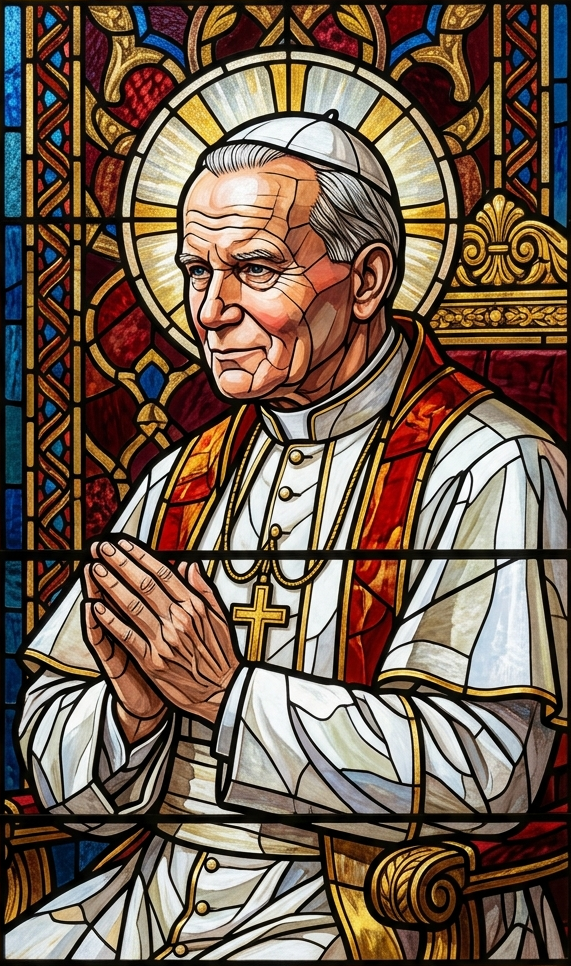
Pope St. John Paul II
1920–2005
Co-patronA quarry laborer and an underground actor before he was a priest, he carried the Gospel into the century’s worst tyrannies and helped bring one down without firing a shot. He wrote the charter for this work: the laity are sent to sanctify the world from within.
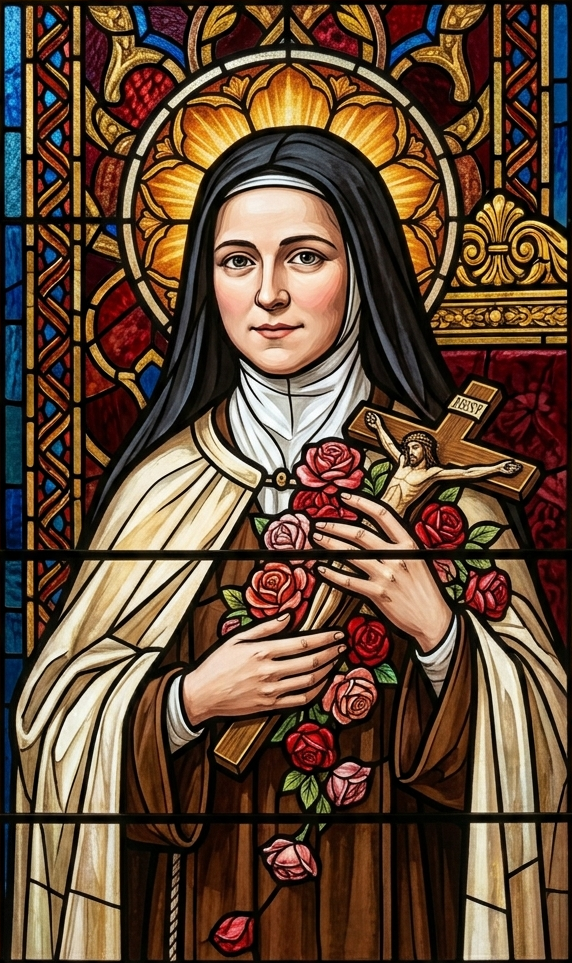
St. Thérèse of Lisieux
1873–1897
Co-patronessA cloistered nun who never held a title and never left her Carmel, yet was named patroness of the missions and a Doctor of the Church. Her “Little Way” teaches that ordinary work done with great love is how the world is actually changed.
One of them helped end an empire. The other never left her monastery. She shows you what holiness looks like. He shows you what it can do in a room where the common good is at stake. We chose both, because neither one alone is the whole of it.
One pathway, three stages, fully funded start to finish: we find you on campus, form you in the tradition, and send you into the work you are called to do. Every profession is a form of citizenship, and we prepare students to exercise that citizenship deliberately, in the light of the Church’s teaching, for the good of others.
Find
We meet you where conviction meets career direction, through your campus ministry, a chapter, or a two-minute application, and bring you into the Civitas Seminar, where you are a Civitas Scholar from your first session. The formation is built for students headed into law, government, business, economics, and public policy, and open to anyone who wants to be formed as a citizen: Catholics, fellow Christians, and all people of goodwill who are enrolled undergraduate or graduate students in the United States, or recent graduates within three years of their degree.
Form
Twice a month on Tuesday evenings, online, you read a primary text of the Church’s teaching in her own words, meet the saint who lived it and the virtue he or she practiced, and study a moment in history when it was put into practice. Over two years, Forming the Citizen and then Building the City, you read from every major social encyclical from Rerum Novarum to Magnifica Humanitas, from the Council, the Summa, and the Catechism. Fifty minutes a session, and you can join at any point in the cycle. Scholars who go furthest are selected for the Civitas Summer Fellowship, a fully funded immersive program in Austin.
Send
You carry the tradition into the work you trained for, in law, government, business, economics, or public policy, or wherever your citizenship takes you, and into the ordinary decisions that work is made of. You leave knowing what the Church teaches, why she teaches it, and how to bring it to bear when the decision is yours. A lifelong network of peers and mentors sustains that witness across a career, tells you the truth when no one else will, and sends the next generation after you.
You bring the conviction. We provide the formation, and the company that sustains it.
Information is not formation. Every dimension of the pathway builds the competence, conviction, and courage you will need for faithful witness in the public square. The formation is anchored in the cardinal and theological virtues and their parts, one virtue a session.
Reason from the Church’s own teaching documents, from Scripture, and from the witness of the saints with enough rigor to put them to work in your own field. The foundation for every decision you will face.
Prayer at every session, the sacramental life, and a spiritual director at the Summer Fellowship. Your own holiness is the first thing, not the extra.
Training in the craft of leadership: deliberation, public speaking, and persuasive writing. The skills you need in the courtroom, in the boardroom, at the statehouse, and at the committee hearing.
A cohort that becomes a lifelong network: the people who keep you faithful across a forty-year career, who will tell you the truth when no one else will, and who send the next generation after you.
We operate under the pastoral guidance of the Diocese of Austin and partner with the campus ministries you already know and trust. This is not separate from your faith. It is your faith, sent into your future.
The University of Texas at Austin
Texas A&M University
Texas State University
Baylor University
University of Houston
Southern Methodist University
Temple University
Rowan University
Texas Tech University
University of Kansas
University of Missouri
The University of Oklahoma
More partnerships in development nationwide. Don’t see your campus? Be the student who brings us there.
The work is running. Now we are building it into a national movement of faithful civic leaders. Whether you want to launch a chapter, partner with us as a campus minister, or invest in the mission, there is a place for you here.
Plant the Institute at your campus. Be a founding chapter president; we hand you the playbook, the materials, and the backing. You bring the students.
Campus ministers, clergy, and university administrators: introduce us to the students you already believe in. We do the rest, at no cost to you or to them.
Every gift removes a financial barrier for a young person called to lead. The model compounds: the same formation serves fifty students or five hundred at the same cost. See the three ways to give →